Programming Model
Legato describes a kernel using execution contexts, typed values, and explicit data movement. These are programming abstractions: the compiler maps a valid program to the selected backend.
LPU compute model
The figure shows the LPU from a programmer's perspective. It is an abstract compute model, rather than an exact diagram of the physical implementation. It describes the execution and memory resources that the compiler can use; the selected backend supplies their configuration and requirements.
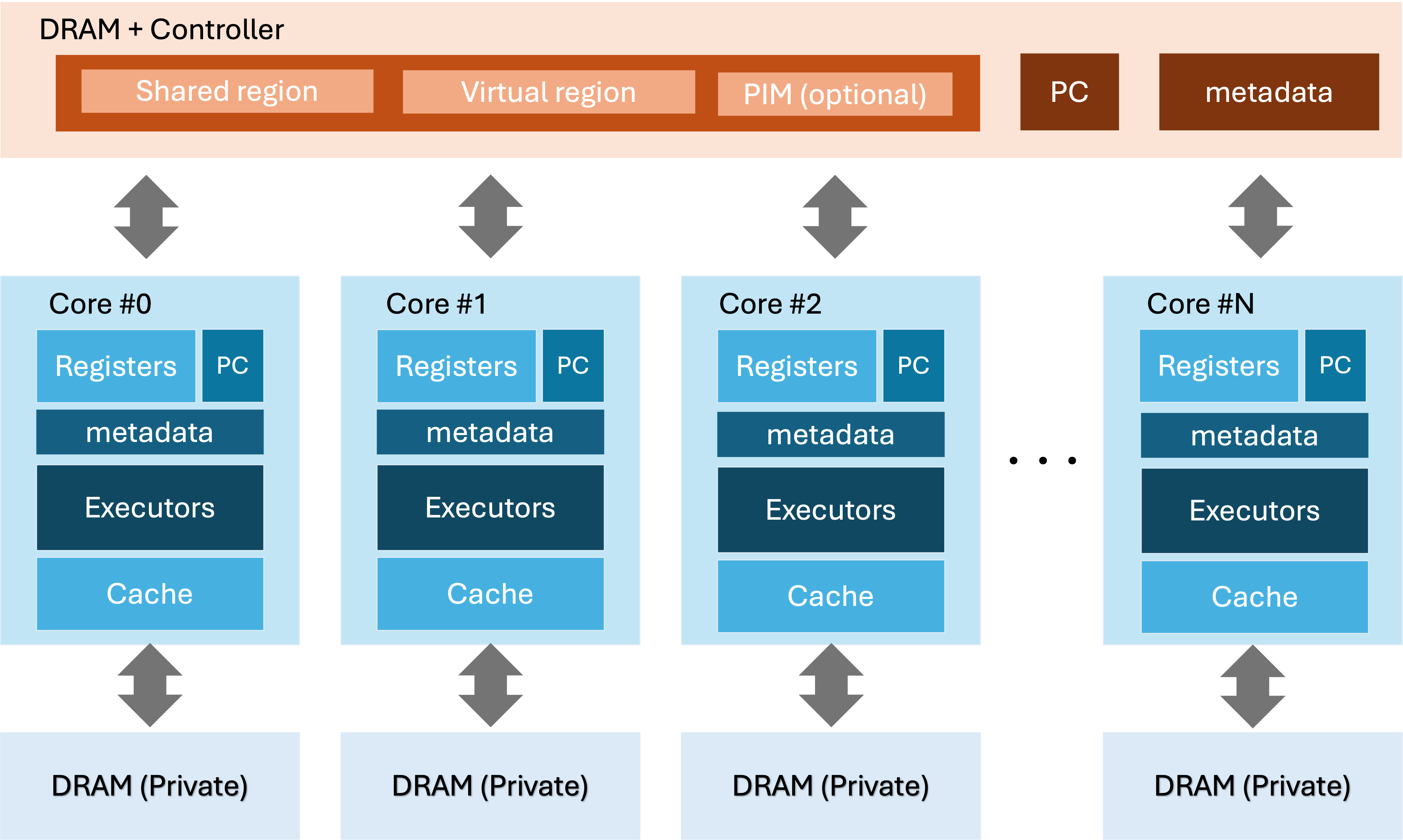
Components and roles
| Component | Programming-model role |
|---|---|
| DRAM + Controller | Provide data from shared DRAM to the cores, independently of core computation. The PC represents its program position, and metadata describes the work being coordinated. |
| Shared and virtual regions | Represent memory shared by the cores. The virtual region represents shared memory accessed through address translation. |
| PIM (optional) | Represent optional processing-in-memory support. Availability depends on the selected compute model. |
| Core #0 through #N | Execute core-local programs. A core has a program counter (PC), registers, execution units, and local memory resources. |
| Execution units | Perform matrix, vector, reshape, and load/store operations. Bertha documentation uses MPU and VPU for the matrix and vector units. The compiler assigns supported operations to suitable units. |
| Cache and private DRAM | Represent core-local memory resources. Cache corresponds to on-chip SRAM in this model; private DRAM represents storage reserved for a core's work. |
The model groups shared DRAM, virtual shared memory, and core-local memory into separate memory spaces. Core memory combines SRAM and private DRAM from the programmer's perspective; the compiler plans placement subject to the selected model's constraints.
Layout maps describe how tensor indices address storage. A memory can impose alignment, shape, and size requirements; padding and swizzling can adapt storage to those requirements or distribute accesses across banks. Logical shape describes the data used by an operation, while physical shape describes its allocated capacity. See Layouts and Memory Kinds.
Execution contexts
| Context | How to select it | Role in a kernel |
|---|---|---|
| Top | device.get_top() |
Coordinate input requests and work shared by the participating cores. |
| One core | device.get_core(i) |
Describe the operations performed by the selected core. |
| Several cores | device.get_cores(...) or device.get_all_cores() |
Describe the work for each participating core. |
Create a backend with the matching device configuration, then obtain its
execution contexts through legato.get_context().get_device(). Keep core
indices within the configured core count.
Values belong to the context where they are defined. Use yield when a value
must leave a context; see Context Management.
Memory and data movement
Tensor types describe the element type, logical shape, physical capacity, and storage kind expected by a kernel. Shared and core-local storage have different allocation scopes and alignment requirements.
| Operation | Programming contract |
|---|---|
legato.tensor.request_load |
Request that an input become available in a target context. |
legato.tensor.receive / receive_type |
Obtain the requested value in that context. |
legato.tensor.memcpy |
Copy a result into an existing tensor or view. |
Pair requests with receives in the documented order. Allocate backing storage that satisfies the declared physical capacity and storage kind; changing an annotation does not allocate or initialize that storage. See Memory Operations and PyTorch Integration.
Device configuration
The configured group and core counts, memory capacities, word sizes, channel count and address spacing, MAC size, and reuse limit constrain valid programs. Use the configuration for the selected device and runtime. A value supported by one backend or revision is not automatically supported by another.
The compiler checks argument binding, shapes, storage requirements, and target support. Successful frontend compilation does not by itself establish binary compilation or device execution support. See Compile Diagnostics.